Observability
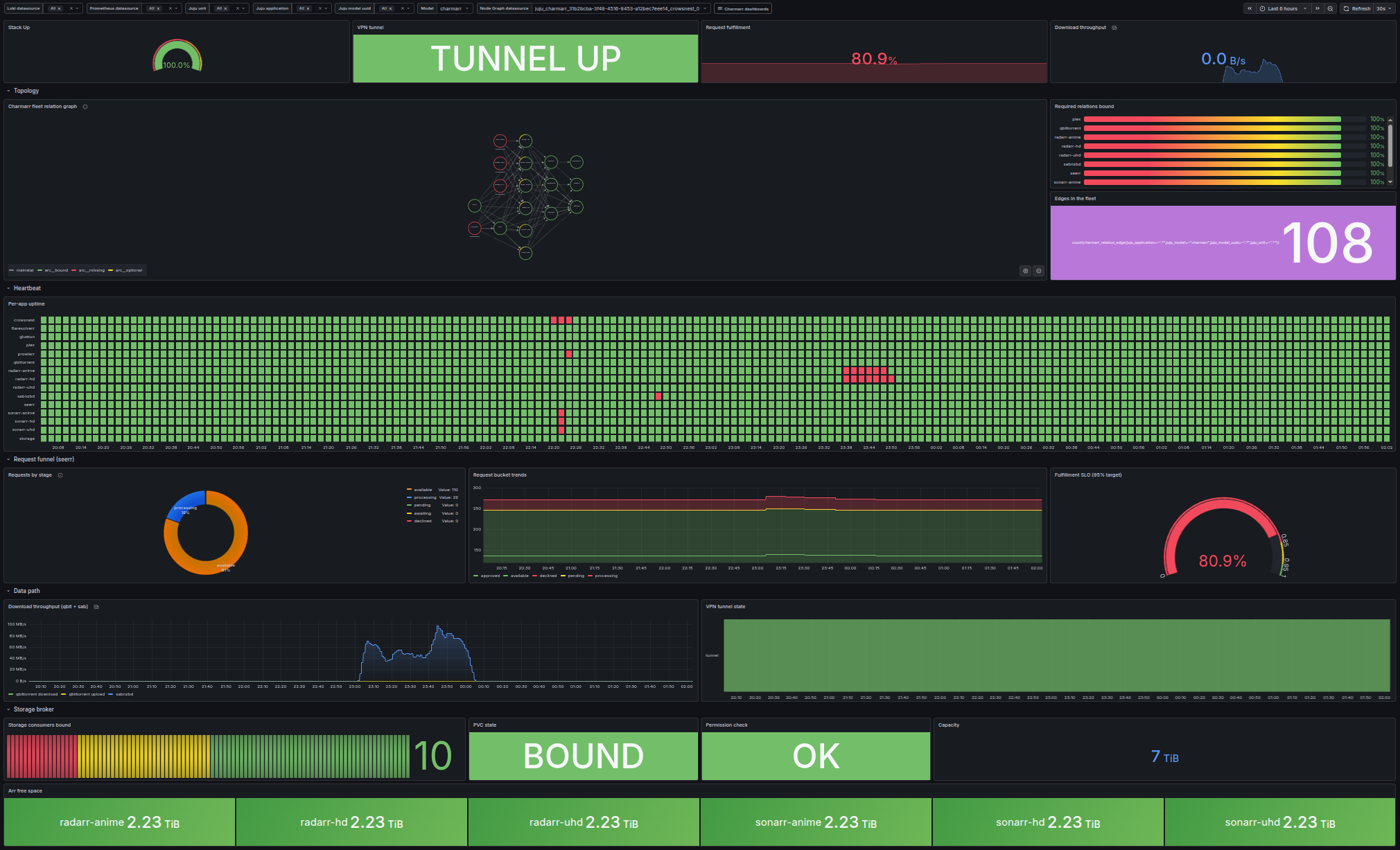
Charmarr is designed from the ground up to integrate with the Canonical Observability Stack (COS). Every charm bundles its own Prometheus exporter, a curated Grafana dashboard, and alert rules. Wire it to COS and you get metrics, logs, traces, and per-app dashboards out of the box. No exporter hunting. No dashboard scavenging. No glue code.
COS is itself a charmed, open-source observability bundle. It ships:
- Mimir for metrics
- Loki for logs
- Tempo for traces
- Grafana for dashboards and datasources
- AlertManager for routing alerts
- OpenTelemetry Collector as the telemetry ingress
Charmarr plugs into all five via standard Juju relations.
What you get out of the box
| Concern | Vanilla K8s | Charmarr + COS |
|---|---|---|
| Per-app exporter | Find, deploy, configure manually | Bundled in the charm sidecar |
| Per-app dashboard | Hunt on Grafana.com, import, tweak | Ships with the charm, auto-imported |
| Alert rules | Author or copy-paste | Curated per charm, auto-published |
| Metrics pipeline | Wire Prometheus or OTel by hand | One juju integrate |
| Logs pipeline | Promtail, Fluent, or OTel by hand | One juju integrate |
| Traces pipeline | OTel collector by hand | One juju integrate |
| Fleet topology graph | Build it yourself | Crowsnest does it |
Hours of ops work collapsed into a relation.
Only COS is officially supported
These docs cover COS only. Other backends are not documented and not officially supported. If you want to forward telemetry to a non-COS backend (Grafana Cloud, Signoz, Datadog, VictoriaMetrics, any OTLP target), it is technically possible by deploying opentelemetry-collector-k8s in the charmarr model and configuring it as a forwarder. You give up auto-imported dashboards and auto-loaded alert rules. Experiments are welcome and PRs adding documented support for additional backends are encouraged.
COS itself is not covered here
Deploying and operating COS is out of scope. See the official COS documentation for installation, scaling, retention tuning, and high-availability patterns.